
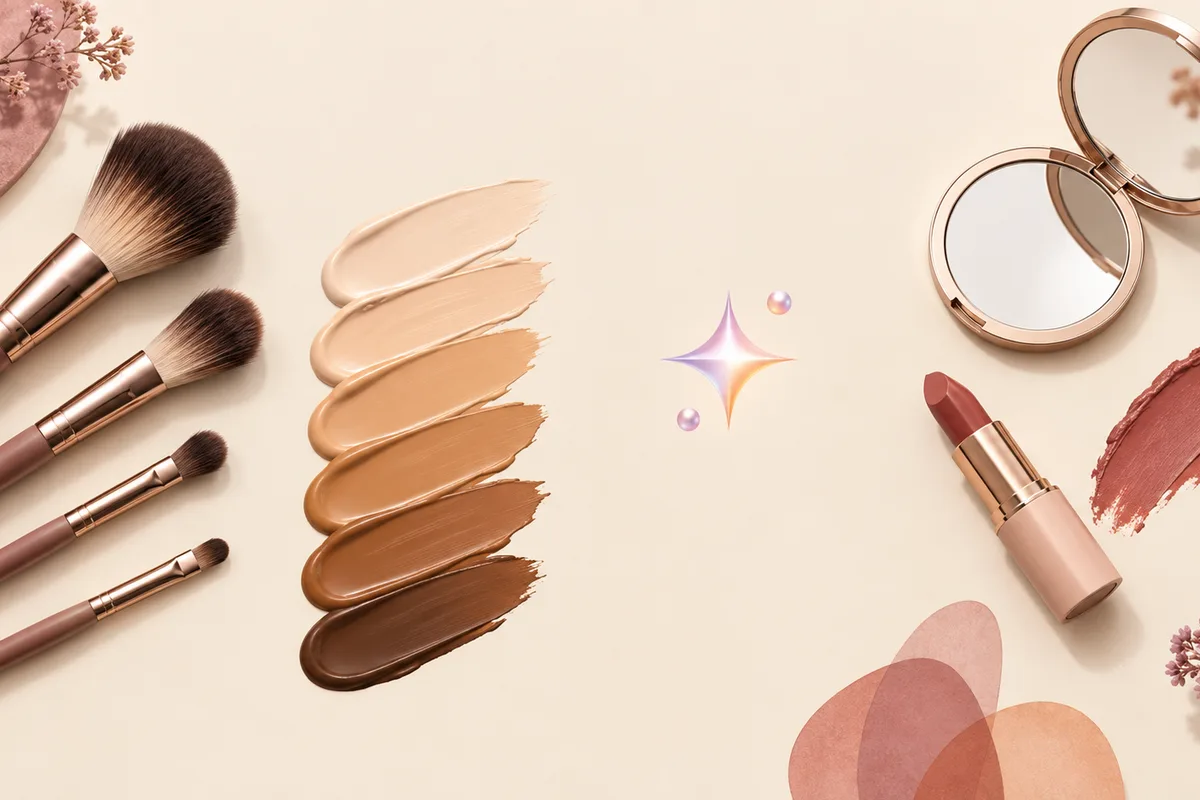
What an AI shade suggestion means
A foundation matcher may estimate color from a photo, compare your stated shade in one brand with another brand's range, or use a questionnaire to suggest a starting point. Those methods are not equivalent. A photo-based tool reads an image under particular camera and lighting conditions; a cross-brand finder depends on its catalog data and mapping rules; a chat response may infer from your description without measuring anything. Always ask what a tool is actually doing before interpreting its answer as a precise match.
SIMAKEUP AI is a multilingual beauty chat service with optional selfie input. It can discuss shade questions conversationally, but should not be treated as a calibrated scanner, a guaranteed shade finder, or a live virtual try-on unless current product information specifically offers those functions. Use chat to organize the facts you know, identify what to test, or prepare questions for a retailer. The final shade decision depends on a real product, a particular formula, your natural coloring, and the lighting in which you want to wear it.
Separate depth, undertone, and formula
Shade descriptions often combine several ideas. Depth describes how light or deep a foundation appears; undertone is the subtle direction of its color, often described as cool, warm, neutral, or olive; and surface redness or visible discoloration may affect the impression without describing the undertone of the whole face. Labels and systems differ by brand, so “medium neutral” in one range may not correspond to the same appearance in another. A useful comparison is to consider depth and undertone independently, then check finish and coverage.
The formula matters too. Different foundations can dry down differently, oxidize for some wearers, or look more luminous or matte after application. A shade that looks right in a bottle or on a screen can change as it is spread into a thin layer. Ask an AI assistant to keep its recommendation modest: request a short set of candidates and the reasoning behind the depth and undertone choice.
Why selfies are unreliable color charts
Your phone is built to make an attractive image, not necessarily to record laboratory color values. Auto exposure and white balance can compensate for a dim room or a bright background. Front cameras can smooth, sharpen, or adjust skin tone; screens vary in brightness and color settings; social apps can compress an image. A warm indoor bulb may make cool shades appear different, while a window with blue light or a colored wall can cast a tint.
Research on skin-tone assessment in prospective studies notes that accurate and consistent assessment depends on factors such as standardized environments, lighting, body areas, and the assessment method. That article discusses measurement in research and healthcare rather than evaluating consumer foundation apps, so it should not be read as a direct performance test of makeup matchers. Its practical relevance is straightforward: an uncontrolled photo is a weak foundation for exact color decisions. A photo can still help you describe broad preferences, but the answer should be treated as a tentative shortlist rather than a colorimetric result.
Give the matcher better information
If you want to ask AI for a foundation shortlist, tell it the exact range and product type you are shopping for, any foundation shade that already matches you, your desired coverage and finish, and whether you are shopping online or can swatch in person. Include useful context such as a seasonal change in skin tone or whether you find many foundations too pink, orange, yellow, or gray. Do not rely on jewelry or vein-color rules as definitive diagnostics; they may be conversation starters, not substitutes for a product swatch.
A clear prompt might say: “My current close match is Brand A, Product B, shade C. I want a medium-coverage satin foundation in Brand D. Please suggest up to three nearby candidates, explain any uncertainty about undertone, and tell me how to test them. Do not say the match is guaranteed.” Provide the exact product versions, because a brand's shades can vary between foundation lines. If you do not have a known reference shade, ask for a testing strategy instead of asking a chatbot to infer an exact shade from a loosely described complexion.
Test candidates on skin, not only on a screen
Whenever possible, swatch a few adjacent shades along the jawline, blending each one toward the neck. Look at the result in indirect daylight as well as the light where you normally wear makeup. The best shade is not always the one that looks most perfect while wet or freshly blended; give it time to dry down and observe it after your usual skincare or sunscreen. If a tester is available, use a clean applicator and follow store hygiene guidance.
Check more than one feature: does the shade create a visible line at the jaw, does its undertone look discordant next to the neck or chest, and is the finish suitable for your preferences? Your face and neck may naturally differ, and some people choose to even them out while others prefer a closer face match; an assistant should explain options rather than declare one universal rule. Foundation is not supposed to erase your natural variation.
Interpret mismatch clues without chasing perfection
If a test shade looks too light, too dark, pink, orange, yellow, or ashy, change one variable at a time. Compare a neighboring depth before switching undertone, or compare a similar-depth shade with a different undertone. This makes it easier to identify whether the issue is the color family, formula, lighting, or the amount applied.
Shade matching has boundaries. A model can be wrong because its catalog is incomplete, shade names are inconsistent, or a photo does not show color faithfully. It may also produce more confident suggestions for some types of images than others. One research finding about skin-tone assessment or AI in a medical setting does not establish the accuracy of a beauty model. Treat inclusion and performance claims carefully, and see whether a retailer offers useful swatches across a broad range. Your own visual comparison and comfort matter more than an app's assessment of which skin category you fit.
Be careful with selfies and sensitive details
A face photo is personal data, and some services may analyze image features as part of processing. Before uploading, read the service's current privacy notice and learn whether a photo is optional, what the service says it will do with it, and whether it describes deletion or sharing. Do not assume that a site retains an image, deletes it immediately, or uses it only for matching without a clear statement. Crop unnecessary background details and avoid names, addresses, school logos, or another person's face. If a written description is enough, keep the image offline.
The Federal Trade Commission's policy statement recognizes that facial images and derived face data can raise consumer privacy and security concerns. This is not a claim that every selfie-matching feature performs identity recognition; facial color estimation and identifying a person are distinct tasks. The important point is to understand what you are sharing and why. Selfie upload to SIMAKEUP AI is optional; consult the site's present privacy disclosures for its handling practices, rather than inferring an image retention promise from the optional feature itself.
A sensible shortlist-to-purchase process
Use a two-stage decision. First, shortlist a handful of candidates based on a known shade, brand chart, formula preferences, and any useful chat or finder suggestions. Second, verify with actual product swatches or samples under realistic conditions. Keep notes on the shade code, formula, application amount, and lighting; a quick photograph can help compare candidates if you keep the lighting and camera settings consistent, but the image is only a record, not a calibrated standard.
Do not let a matching score create pressure to buy. If two shades are close, consider whether you would use a concealer or sheer application differently, but avoid buying extra items unless they solve a real need. Check ingredients if you have known sensitivities and remember that a color match says nothing about skin compatibility. AI can help you ask better questions, but it cannot test the formula, feel the wear, or promise a flawless result. The most trustworthy answer may be “these are candidates; test them before deciding.”
Frequently asked questions
Can AI match my foundation shade exactly from a selfie?
No tool should be assumed to guarantee an exact match from a selfie. Lighting, camera processing, screen settings, formula, and brand shade systems all affect the result.
Where should I test a foundation shade?
When possible, apply a few close candidates along the jawline toward the neck and compare them after they dry in indirect daylight and the lighting where you normally wear makeup.
Can SIMAKEUP AI scan my skin tone?
SIMAKEUP AI is a multilingual beauty chat service with optional selfie input. Do not assume it offers a calibrated scan or guaranteed shade match; consult current product details.
Does my undertone change when I tan?
Your visible depth can change with seasonal exposure, and the shade that blends best may change too. Re-test candidates rather than assuming a year-round match.
Sources and further reading
The sources below support safety, skincare or technology context. Application advice is general educational guidance, not a claim of hands-on product testing or expert medical review.